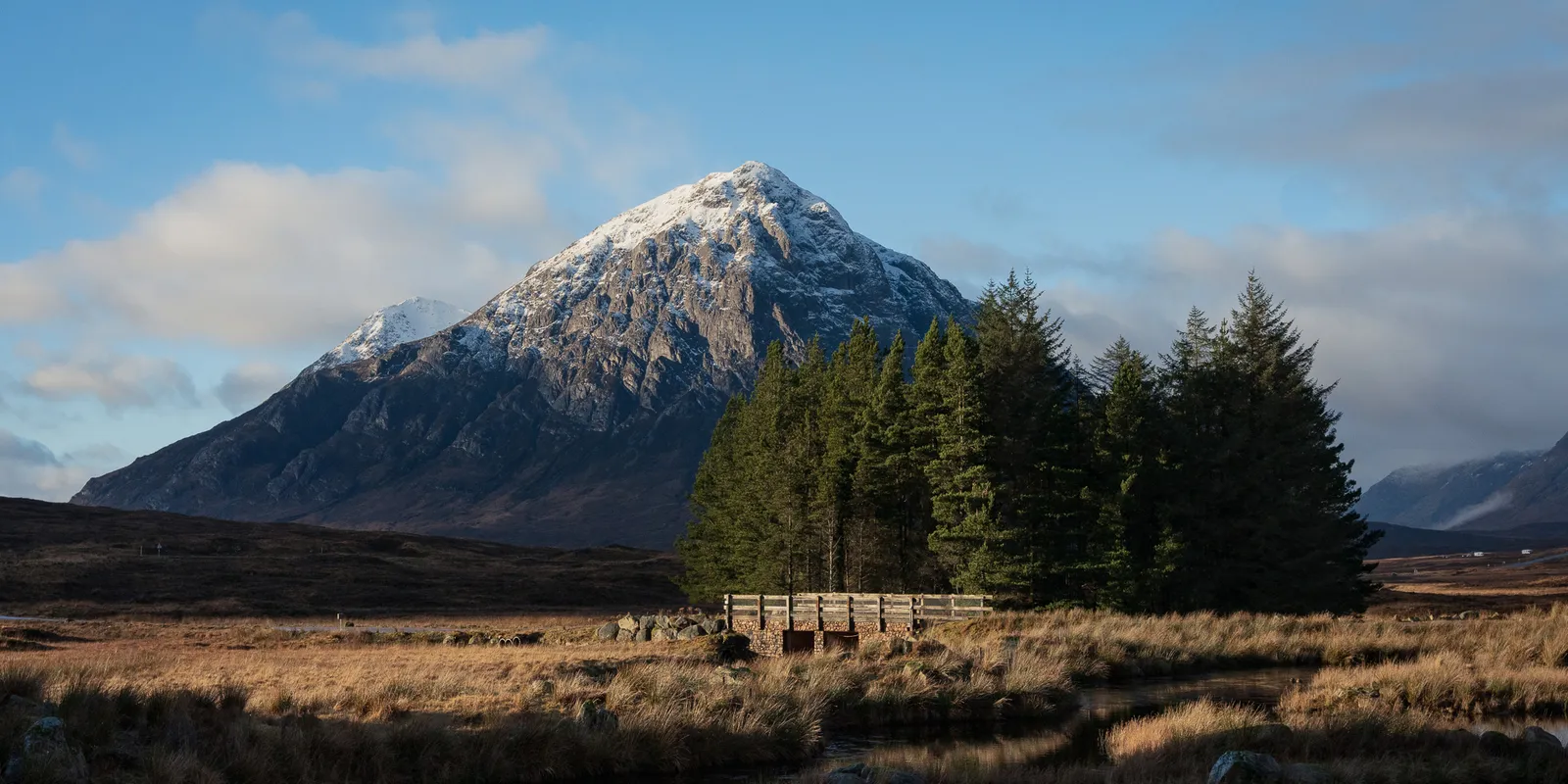
If you’ve spent any time poring over an OS map of the Scottish Highlands, like me, you’ll probably have noticed that the mountain names are unlike anything else in Britain. Beinn Dorain. Sgùrr nan Gillean. Càrn Mòr Dearg. Stob Coire Sgreamhach. They roll off the tongue in unfamiliar ways, full of consonant clusters and accented vowels that don’t follow English rules at all.
They’re Gaelic — specifically Scottish Gaelic (Gàidhlig), a language with roots going back over a thousand years in the Highlands. And unlike many place names in England that have been anglicised beyond recognition, Scottish mountain names still carry their original Gaelic meaning remarkably clearly.
Over the years, I’ve been trying my best to pick up some of the lingo, but it’s fairly difficult when you’re not practicing it every day. However, I figured, at least for my own learning, that pulling together this guide might be a helpful way to make some of that gaelic stick.
It’s often easier to remember these words when there are strong associations and memories. “Hey, I climbed Càrn Dearg, oh that means ‘the red rocky hill’”.
The Building Blocks: Landform Words
Most mountain names are descriptive compounds. A summit is named for its shape, its colour, its position relative to other peaks, or a feature of its corrie or ridge. These are the core landform words you’ll encounter most often.
Beinn / Ben — Mountain
Beinn (anglicised as Ben) is the most common word for mountain in Scotland. It appears in hundreds of names: Ben Nevis, Ben Lomond, Beinn Dorain, Beinn a’ Chròin. On its own it simply means “mountain” or “peak”, but it usually appears as the first word in a compound, with the descriptive element following.
Beinn Dorain — Mountain of the Streamlet (or possibly of the Otter)
Sgùrr / Sgòrr — Sharp Peak
Sgùrr (sometimes spelt Sgòrr) describes a sharp, rocky, pointed summit. It’s particularly common on the Isle of Skye and in the Torridon and Knoydart ranges, where the geology produces dramatic rocky spires.
Sgùrr nan Gillean — Peak of the Young Men (or Gullies) Sgùrr Alasdair — Alexander’s Peak (named after Sheriff Alexander Nicolson, first to summit it)
Càrn — Cairn or Rocky Hill
Càrn refers to a hill with a rounded, stony summit, often with a cairn on top. It’s common in the Cairngorms (the name itself derives from Am Monadh Ruadh — the Red Mountains — though Càrn Gorm means “Blue Cairn”).
Càrn Mòr Dearg — Big Red Cairn Càrn a’ Mhàim — Cairn of the Pass
Stob — Peak or Point
Stob literally means “point” or “stump” and describes a subsidiary peak, often one in a ridge of several summits. Glencoe and the Mamores are full of Stobs.
Stob Coire Sgreamhach — Peak of the Horrible Corrie Stob Binnein — Peak of the Pinnacle
Meall — Rounded Hill
Meall describes a rounded, dome-like hill without sharp features. Many Mealls are gentler, more rolling summits.
Meall Garbh — Rough Rounded Hill Meall nan Tarmachan — Hill of the Ptarmigan
Bràigh / Braigh — High Ground or Upland
Bràigh refers to upland ground or a high plateau. You’ll find it in names like Bràigh Coire Chruinn-bhalgain — one of the longer Munro names in the book.
Mullach — Summit, Top
Mullach means “summit” or “top” and tends to describe a broad, high point.
Mullach Fraoch-choire — Summit of the Heather Corrie Mullach Coire Mhic Fhearchair — Summit of the Corrie of Farquhar’s Son
Monadh — Moorland, Mountain Range
Monadh refers to a range or extensive upland rather than a single peak. The Monadhliath (Grey Moorland) and Monadh Ruadh (Red Moorland, now called the Cairngorms) use this word.
Corrie Words
A corrie (from coire) is the bowl-shaped hollow carved by glaciers on the flanks of mountains. Scottish Gaelic has a rich vocabulary for the features of corries.
| Gaelic | Meaning |
|---|---|
| Coire | Corrie, hollow, cauldron |
| Coire an t-Sneachda | Corrie of the Snow |
| Coire an Lochain | Corrie of the Lochan |
| Choire (lenited form) | Of the corrie |
The lenited form choire (pronounced roughly chorr-uh) appears when “of the corrie” follows another noun — so Stob Coire becomes Stob Choire in some constructions, depending on grammatical gender.
Descriptive Adjectives
These adjectives appear constantly in mountain names, often following the main noun.
| Gaelic | Meaning | Example |
|---|---|---|
| Mòr / Mhòr | Big, great | Càrn Mòr Dearg |
| Beag | Small | Beinn Beag |
| Dearg | Red | Càrn Dearg |
| Gorm | Blue | Càrn Gorm |
| Ruadh | Reddish-brown | Meall Ruadh |
| Garbh | Rough | Stob Garbh |
| Donn | Brown | Beinn Donn |
| Dubh | Black | Beinn Dubh |
| Bàn | White, pale | Sgùrr Bàn |
| Fionn | Fair, light | Beinn Fhionnlaidh |
| Liath | Grey | Monadhliath |
Colours in Gaelic mountain names almost always describe the rock colour or the look of the slope in particular conditions — Dearg (red) often refers to reddish granite, Liath to grey schist, Dubh to dark rock or shadow.
Possession and Genitive Forms
Gaelic is a highly inflected language, which means words change their form depending on their grammatical role. The genitive case (indicating “of”) is particularly important for mountain names, and it often causes the first letter of a word to change — a process called lenition.
In lenition, certain consonants gain an h after them:
- B → Bh (pronounced like a V or W): Beinn → na Beinne → Bheinne
- C → Ch (pronounced like loch): Coire → a’ Choire
- M → Mh (pronounced like V or W): Mòr → a’ Mhòr
- G → Gh (often silent or like a soft Y): Garbh → a’ Gharbh
- S → Sh (often silent): Sgùrr → an t-Sgùrr
This is why Stob Coire Sgreamhach becomes Coire na Ciste with Ciste (chest) rather than Caiste, and why the same word can look very different depending on its position in a name. Don’t be put off — the underlying roots are consistent once you spot them.
People and Stories in the Names
Not all mountain names are purely descriptive. Some preserve names of people, events, or mythology.
Sgùrr Alasdair on Skye is named after Alexander Nicolson, who made the first recorded ascent in 1873. Bidein Druim nan Ràmh (Peak of the Ridge of the Oars) on Skye may recall an ancient portage route. Beinn a’ Chaorainn (Mountain of the Rowan Tree) is a name found in multiple parts of Scotland, reflecting how important the rowan was to Highland communities.
Mullach Coire Mhic Fhearchair — Summit of the Corrie of Farquhar’s Son — preserves a personal name in a form so old and compressed that the original Farquhar is long forgotten.
Pronunciation: A Rough Guide
Scottish Gaelic pronunciation is notoriously difficult for English speakers, but a few rules go a long way:
- Bh / Mh — usually pronounced like a V or W
- Ch — like the ch in loch, never like church
- Gh — soft, often barely audible; sometimes like a Y
- Sh / Th — usually a soft H sound, or sometimes silent
- Àì / è — accented vowels are long; à = long AH, è = long EH
- Sn / Sr — the S is usually silent before these consonants
So Sgùrr is roughly Skoor, Coire is roughly Corr-uh, Beinn is roughly Ben (with a slightly nasalised vowel), and Bheinn is roughly Ven or Wen.
Why It Matters
Learning even a little Gaelic vocabulary changes your experience of the hills. When you know that Coire an t-Sneachda means “Corrie of the Snow”, you’re not just navigating to a grid reference — you’re reading a description written by people who lived and worked in this landscape for centuries, who named places by what they saw and felt there.
Scotland’s mountain names are a living archive of the Gaelic language and of Highland culture. Many of the communities that spoke this language were cleared from the glens during the 18th and 19th centuries, but their words remain on every map, on every hillside, on every summit cairn.
When you stand on the top of Beinn Dorain and look out over Rannoch Moor, you’re standing on a name. It means something. And that’s worth knowing.
If you’d like to explore more, Dwelly’s Gaelic Dictionary (available free online) is the definitive reference, and the website Ainmean-Àite na h-Alba (Gaelic Place-Names of Scotland) has detailed notes on hundreds of Highland names.