Munro · No. 3 + 4 · Ben More and Stob Binnein — Route Guide — Ben More: The Great Mountain; Stob Binnein: Pointed Peak
Munro · No. 3 + 4 · Ben More and Stob Binnein — Route Guide — Ben More: The Great Mountain; Stob Binnein: Pointed Peak
Small car park at Ben More Farm on the A85 near Crianlarich. Free parking at the farm entrance — arrive early on busy days.
Ben More is one of those mountains you can see from miles away. That unmistakable steep-sided cone dominates the view as you drive through Glen Dochart, and if you’ve been putting it off because of its reputation — well, the reputation is fully earned. This is the closest thing to a stairmaster workout you’ll find in the Scottish mountains.
We tackled Ben More and its neighbour Stob Binnein together as a double-bagger, which is the way most people do it. Standing at 1,174m and 1,165m respectively, they’re the highest peaks in the Southern Highlands and the views from both summits are spectacular. But you have to work for them.
The standard route takes you up the north-west face of Ben More directly from the A85, across the bealach (mountain pass) between the two peaks, up Stob Binnein, and then back down via the bealach to retrace your steps. It’s an out-and-back with a big horseshoe feel to it.
The hike starts from the small car park at Ben More Farm, right on the A85 between Crianlarich and Killin. It’s well signposted and easy to find — if you’re coming from Glasgow it’s about 90 minutes up the A82 and then along Glen Dochart.
As with many Southern Highland munros that are within easy reach of the Central Belt, this one gets busy. On a summer weekend you’ll want to arrive early to secure a parking spot. We got there at a reasonable time and still managed to find a space, but by the time we were heading back down, cars were lining the verge.
There’s no gentle warm-up here. From the moment you leave the car park, you’re climbing. The path heads straight up the north-west face of Ben More and doesn’t let up until you reach the summit.
The lower slopes are grassy and can be boggy after rain, but the gradient is immediately noticeable. Within the first 20 minutes your legs will be reminding you that this isn’t a gentle stroll around Loch Lomond. The path is well-worn and easy enough to follow, but it’s steep — we’re talking relentless, “why did I agree to this” steep.
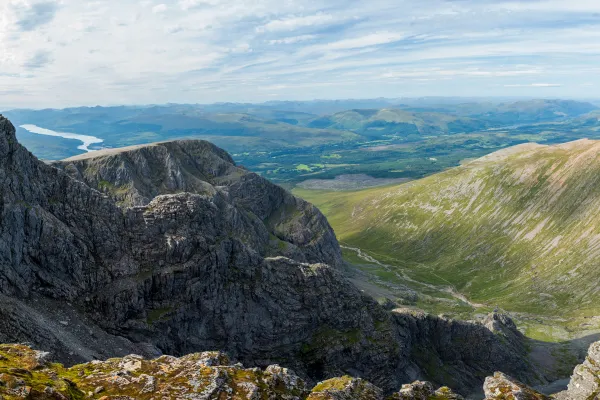
As you gain height, the grassy slopes give way to rockier terrain and the views start opening up behind you across Glen Dochart and over towards the Tarmachan Ridge. Every time you stop to catch your breath (and you will stop), the expanding panorama is a good excuse to pretend you’re admiring the view rather than questioning your life choices.
Higher up there’s a short rocky section that involves a mild scramble. It’s nothing too technical — hands-on-rock for a few moves — but in wet or icy conditions it demands a bit more care. You can skirt around it slightly to the left if you’d rather avoid it entirely.
And then, after what feels like a very long time of going almost vertically upwards, you hit the summit ridge and suddenly the world opens up.
The summit of Ben More sits at 1,174m, making it the highest point in the Southern Highlands and the 16th highest mountain in Scotland. The cairn is large and on a clear day the views are absolutely worth every burning leg muscle it took to get there.
To the west you can pick out Ben Lui and, on a really clear day, the Isle of Mull. To the north, the Breadalbane hills and the Ben Lawers range stretch across the horizon above Loch Tay. To the south, the Arrochar Alps — including Beinn Ime and Beinn Narnain — and Loch Lomond make for a pretty dramatic backdrop. It’s one of those summits where you want to just sit and take it all in — we certainly did.
From the summit of Ben More, the route heads south towards Stob Binnein. The descent off Ben More is rocky and steep at first, and there’s one short section where you need to down-climb a small rock wall. Again, you can bypass this by diverting slightly to the left, but it’s straightforward enough in good conditions.
The path drops down to the Bealach-eadar-dha Bheinn (the pass between the two hills) at around 862m, marked by a large boulder. This is a good spot to stop for something to eat — you’ve just descended over 300m from Ben More and you’re about to climb another 300m up to Stob Binnein.
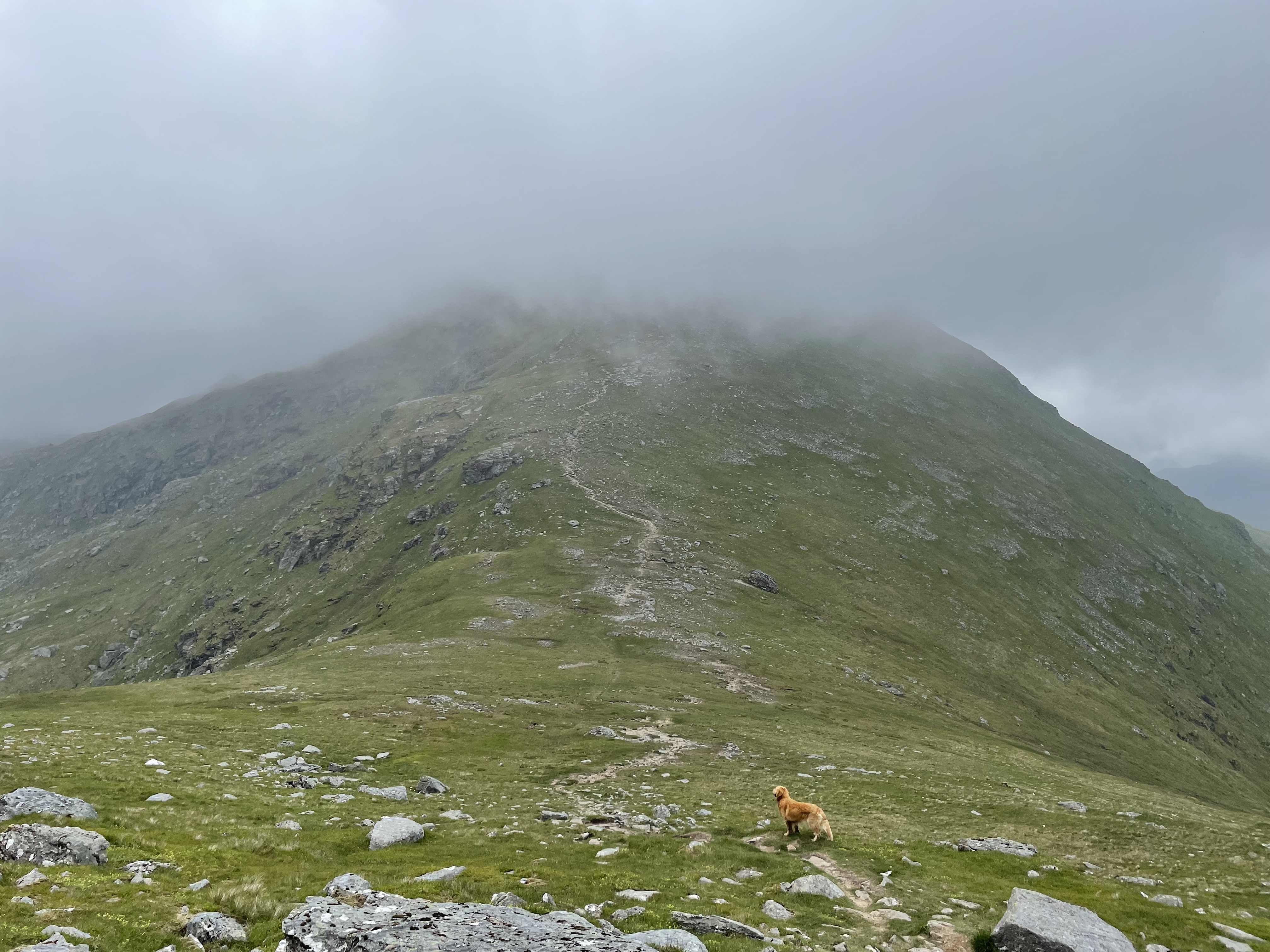
We took a few minutes here to refuel and to appreciate the scale of the landscape. Looking back up at Ben More from below, you get a real sense of just how steep that face is. Looking ahead at Stob Binnein, the north flank rises up in a more uniform gradient — still steep, but it felt less brutal after what we’d just come down.
The climb up to Stob Binnein from the bealach is steep but somehow more forgiving than Ben More’s front face. Maybe it’s because the path is slightly better defined, or maybe our legs had just accepted their fate at that point.
The summit of Stob Binnein (Pointed Peak) stands at 1,165m — only 9 metres lower than its neighbour. Despite the minimal height difference, Stob Binnein tends to feel quieter. Some people only climb Ben More and skip the traverse, so if you do make the effort to bag both, you might have this summit more to yourself.
The views from here are different enough to feel rewarding — you get a particularly good perspective looking back across at Ben More’s steep flanks, and the southern outlook towards Cruach Ardrain and the Crianlarich group is excellent.
For the return, we retraced our steps back over the bealach and descended Ben More’s north-west face. Coming down the steep slopes is hard on the knees, and we were both feeling it by the bottom. Take your time, especially on the rocky sections and the short scramble which is trickier in descent.
An alternative descent option from the bealach is to head north-east down into the Benmore Glen rather than re-ascending Ben More, but this involves pathless, boggy terrain and a longer walk back along the road to the car park. Most people take the direct route back over Ben More.
By the time we reached the car, we’d been out for around 8.5 hours and our legs were absolutely done. This is a big day out by anyone’s standards.
Summer (May–September) is the best window for this route. The long days give you plenty of time, and the grassy lower slopes dry out somewhat. Even in summer, the summit can be windy and significantly colder than the valley — bring layers regardless of how warm it looks at the car park.
Autumn and Spring can be excellent if you hit good weather, but be prepared for boggy conditions on the lower slopes and the possibility of ice on the upper sections.
Winter is a serious undertaking. The steep north-west face of Ben More becomes a proper mountaineering proposition in snow and ice, requiring crampons, an ice axe, and the skills to use them. The short scramble on the descent becomes considerably more exposed. This is not one to underestimate in winter conditions.
Ben More and Stob Binnein are typically done together. Adding a third Munro to this day would be ambitious given the total ascent involved. However, the Crianlarich area is packed with excellent Munros if you’re staying for a few days — Cruach Ardrain and Beinn Tulaichean are just down the road, and An Caisteal and Beinn a’ Chròin can be accessed from a layby on the A82 nearby.
How hard is Ben More? Ben More is one of the more physically demanding Munros due to the relentless steep gradient. The north-west face gains over 1,000m of elevation with very little respite. It’s not technical, but it requires good fitness and determination.
Can you do Ben More and Stob Binnein in a day? Yes — most people tackle them together as a single outing. Allow 6–9 hours depending on fitness and conditions. The traverse between the two via the bealach is the standard approach.
Where do you park for Ben More? Ben More Farm on the A85 between Crianlarich and Killin. It’s free but limited — arrive early on weekends and bank holidays.
Is Ben More suitable for beginners? The steep, unrelenting gradient makes this a tough introduction to Munro bagging. If you’re new to hillwalking, consider starting with something gentler like Meall Bhuide or Schiehallion to build up your fitness and confidence first.
Is Ben More suitable for dogs? Dogs are allowed but this is a demanding route for them. The steep, rocky terrain and the scrambling section on the descent from Ben More can be difficult for dogs — we had to lift Lewis over a similar scramble on An Caisteal and it wasn’t fun. If your dog is experienced on mountains and comfortable on steep, rocky ground, it’s doable, but keep them on a lead near livestock at Ben More Farm and be honest about whether the terrain suits them.