Munro · No. 42 + 43 + 44 + 45 · Càrn Gorm, Meall Garbh, Càrn Mairg and Meall nan Aighean — Glen Lyon 4-Munro Circuit — Càrn Gorm: Blue Cairn; Meall Garbh: Rough Hill; Càrn Mairg: Cairn of Sorrow; Meall nan Aighean: Hill of the Hinds
Munro · No. 42 + 43 + 44 + 45 · Càrn Gorm, Meall Garbh, Càrn Mairg and Meall nan Aighean — Glen Lyon 4-Munro Circuit — Càrn Gorm: Blue Cairn; Meall Garbh: Rough Hill; Càrn Mairg: Cairn of Sorrow; Meall nan Aighean: Hill of the Hinds
Small free car park at Invervar, Glen Lyon. Fills quickly on weekends — permitted overflow parking is available 1km further up the road (flat road, adds ~30 minutes to the day).
The day after the Glen Lyon 4-Munro circuit, our legs could feel every single one of those 1,476 metres of ascent. This was our biggest total elevation day since we started Munro bagging — and writing up the report the morning after, with stiff quads and a cup of coffee, it’s safe to say it earned that title.
Càrn Gorm, Meall Garbh, Càrn Mairg and Meall nan Aighean form a natural horseshoe above Invervar in Glen Lyon, one of the longest and most beautiful glens in Scotland. At 21.93km with nearly 1,500m of climbing across four distinct summits, this is a proper full day in the hills — and a deeply satisfying one at that.
| Munro Name | Pronunciation | Translation | Height |
|---|---|---|---|
| Càrn Gorm | Karn Gorom | Blue Cairn | 1,029m |
| Meall Garbh | Myowl Garrav | Rough Hill | 968m |
| Càrn Mairg | Karn Marik | Cairn of Sorrow | 1,042m |
| Meall nan Aighean | Myowl nan Eye-en | Hill of the Hinds | 981m |
The circuit starts from Invervar in Glen Lyon, reached by driving the full length of the glen from Kenmore. From Perth, allow around an hour; from Edinburgh, approximately 90 minutes to two hours; from Glasgow, closer to two hours via the A82 and then east through Killin or north through Crieff.
The main car park at Invervar is small and fills quickly on good-weather weekends — we arrived to find it already full. Permitted parking is available approximately 1km further up the road, and while this adds roughly 30 minutes to the day, the road is flat and the extra walking is easy on the legs. If you’re planning this route on a summer weekend, an early start is well worth it.
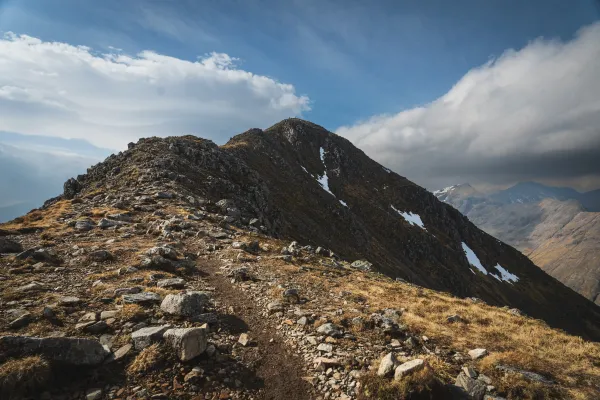
Càrn Gorm demands respect from the outset. The lion’s share of the day’s total elevation comes on this first ascent, and the mountain throws in two false summits for good measure before you reach the actual top. Pace yourself here — the circuit still has three more Munros ahead, and burning too much on the first climb is an easy mistake to make.
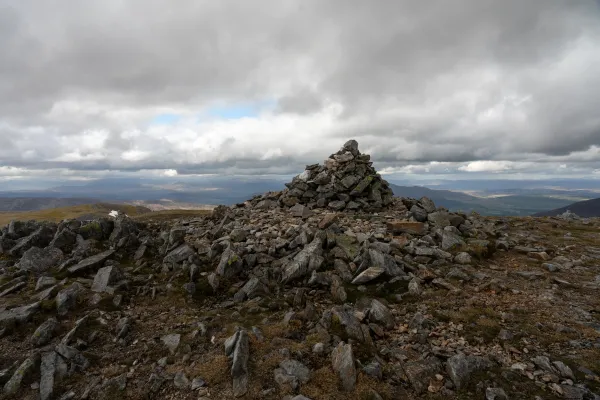
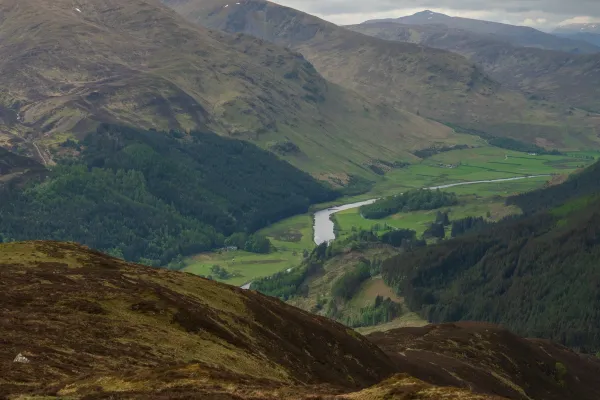
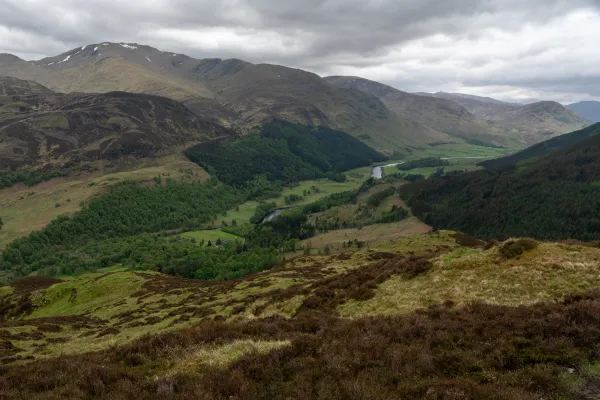
The path is well-defined and the terrain underfoot is generally good, with only a touch of bog on the lower sections. As you gain height, the views across Glen Lyon open up and the scale of the horseshoe ahead starts to become clear. The true summit cairn, when you finally reach it, comes with a sense of hard-won satisfaction — and a reminder that you’re barely a quarter of the way around.
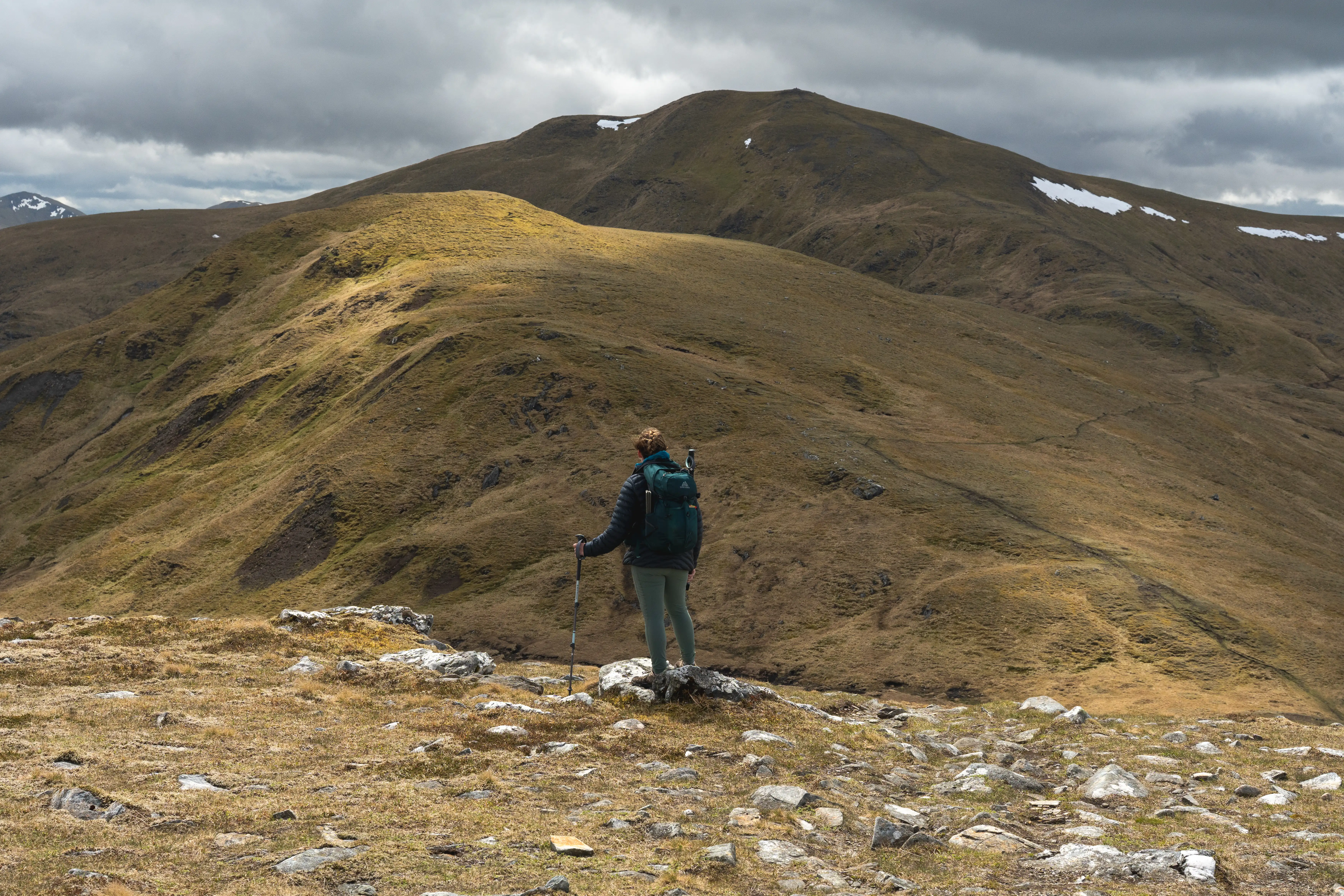
Conditions on our day were consistently overcast, with a 35mph wind that meant the warmth of the climb was quickly stripped away whenever we stopped moving. A windproof layer is not optional on this circuit.
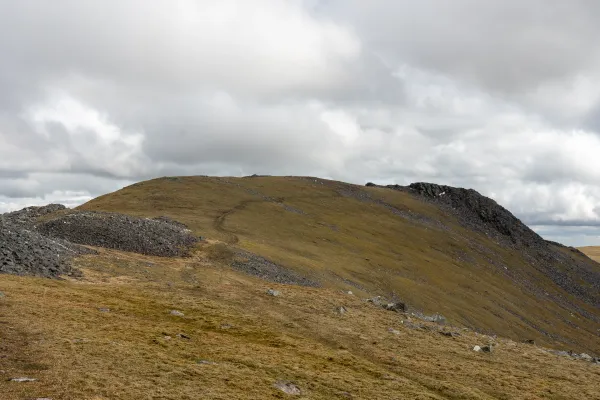
The ridge walk from Càrn Gorm to Meall Garbh is one of the more pleasant sections of the day. The gradient eases and the terrain becomes more open, with the path well-defined underfoot.
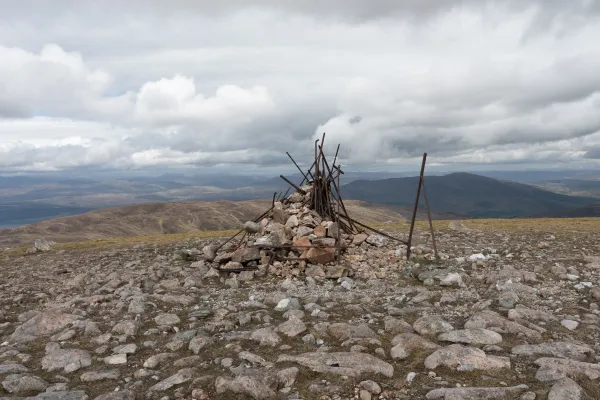
Meall Garbh has one of the most distinctive summit cairns we’ve encountered so far in our Munro bagging — a substantial pile of stone topped with sections of old metal fencing, giving it an unusual and memorable character.
Just beyond the summit we found a sheltered spot out of the wind and took the opportunity to stop for lunch and a proper rest. With two Munros still ahead and the 35mph wind having been a constant drain on energy, the break was well earned. If you’re doing this circuit, Meall Garbh is a natural halfway point — take the time to eat, refuel, and reset before tackling the more demanding second half of the day.
Càrn Mairg is the highest point of the day at 1,042m and the most technically demanding summit on the circuit. The approach to the cairn involves a boulder field that requires more careful footing than anything else on the route, and the descent from the summit towards the fourth Munro needs attention — the terrain is rougher and the path is less clear in places.
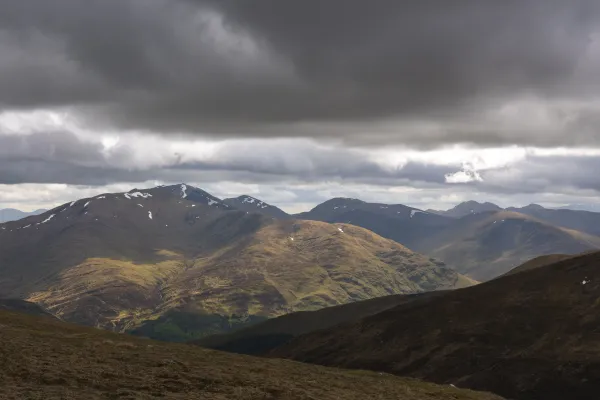
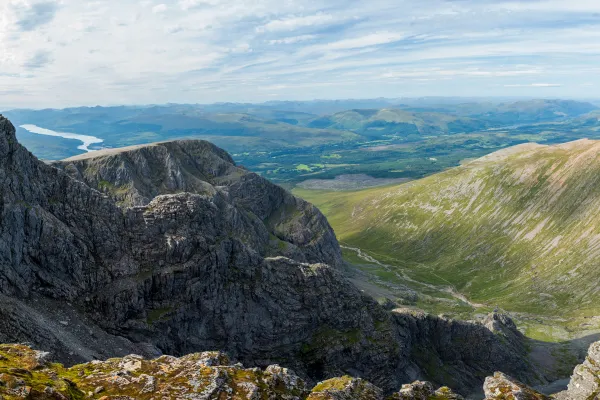
Take your time on Càrn Mairg. The summit views are among the best of the day, with Glen Lyon laid out far below and the breadth of the Perthshire hills stretching out in every direction. On a clear day this would be exceptional — even in overcast conditions it was striking.
Coming off the summit heading south-east towards Meall nan Aighean, keep a close eye on your GPS or map. The descent path is initially indistinct and there are a few false lines to follow.
The fourth and final Munro of the day, Meall nan Aighean, brings a sense of relief — the hardest climbing is behind you and the summit, while still requiring effort after nearly 8 hours on the hill, comes without the technical challenges of Càrn Mairg.
The walk back to Invervar from Meall nan Aighean is, for the most part, pleasant on the legs — a gradual descent on reasonable terrain. However, we did lose the path once, following what turned out to be a quad bike track rather than the walking route. A short backtrack was all it took to regain the correct line, but at the end of a long day it’s the kind of minor frustration that’s worth flagging. Keep an eye on your GPS and don’t assume every obvious track leads where you want to go.
We also lost the path briefly coming down from Meall nan Aighean itself, but picked it back up again without too much difficulty.
The day was consistently overcast with a steady 35mph wind throughout — not ideal for photography, and a significant factor in heat management. Even on a mild-temperature day, stopping for any length of time in that wind drains warmth quickly. Carry a proper layer system and don’t assume that a comfortable temperature at the car park translates to comfortable conditions on the ridge.
We also heard, after returning to the van, that a hiker had gone missing on the same day on the eastern Ben Lawers Munros — the range that sits just to the south-east of Glen Lyon. It’s a sobering reminder that these are serious hills, and that communication matters. We’re seriously considering a Garmin InReach Mini or similar personal locator beacon — the ability to send a location to someone at home at each summit, or to call for help in a genuine emergency, seems increasingly like a sensible investment the further we get into this list.
If you’re heading into the hills, tell someone your route and your expected return time. Check in when you can.
Summer (May–September) gives the long days this circuit needs — an 8h45m day demands daylight to spare. The glen is at its greenest and the long ridge walk between summits is at its best.
Autumn (October–November) would be excellent for this circuit — the golden tones of the glen and the clarity of an autumn day would make the views from Càrn Mairg something special.
Winter (December–March) is serious terrain. All four summits sit at or above 968m, the wind exposure is significant, and the boulder field approaches become considerably more challenging in snow and ice. Crampons and ice axe likely required. That said, these hills with their winter coats on would be a spectacular sight — arguably more photogenic than the overcast May conditions we experienced.
Spring (April–May) can offer good conditions but expect lingering wind and some boggy ground on the lower sections. Check MWIS forecasts carefully.
The Glen Lyon Munros pair naturally with a visit to Stuchd an Lochain and Meall Bhuide, both accessible from Loch an Daimh further west along Glen Lyon, for a multi-day stay in the area.
Ben Lawers and Beinn Ghlas are the most prominent neighbours, accessible from the south side of the loch — and Meall Corranaich and Meall a’ Choire Leith complete the Lawers range for a serious multi-day Perthshire campaign.
How hard is the Glen Lyon 4-Munro circuit? This is a strenuous, full-day route. The total ascent of 1,476m across 21.93km makes it one of the bigger days in this part of Perthshire. All four summits are well above 900m, the wind exposure on the ridge is real, and the boulder field on Càrn Mairg requires careful footing. It’s suitable for experienced hillwalkers with previous multi-Munro days under their belt, but not recommended as a first or second Munro outing.
How long does the Glen Lyon circuit take? Allow 8–9 hours for a comfortable day with stops. We covered it in 8 hours 45 minutes total with around 7 hours of moving time. Fitter, faster parties could push closer to 7 hours total.
Where do you park for the Glen Lyon Munros? The main car park is at Invervar at the end of the public road in Glen Lyon (PH15 2PP). It’s small and free. On busy weekends it fills early — permitted overflow parking is available approximately 1km further up the road.
Is there water on the route? Some streams on the lower sections, but they become scarce as you gain height. We’d recommend carrying at least 2 litres from the car park and treating any stream water you do filter given the sheep activity on the lower terrain.
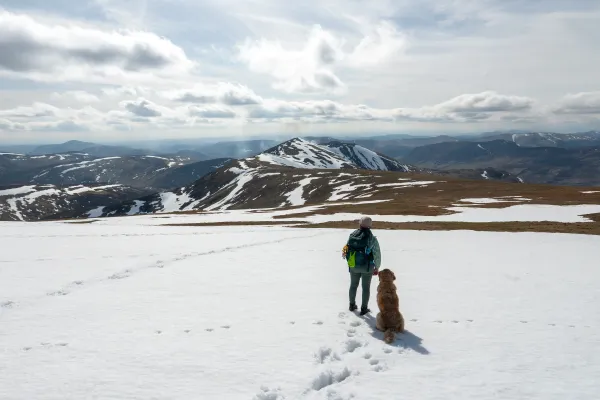
Are the Glen Lyon Munros suitable for dogs? Yes — well-conditioned dogs should manage this circuit. Our golden retriever completed it without difficulty. The main consideration is the boulder field on Càrn Mairg, where sure footing is needed, and the total distance (21.93km) makes this a serious day for a dog as well as a person.
What’s the best time of year to climb the Glen Lyon circuit? The long days of summer make logistics easier for this ~9 hour circuit. That said, the hills in their winter coats would be far more photogenic — overcast May conditions made photography difficult on our visit. Autumn would also be an excellent choice for colour and visibility.